Introduction
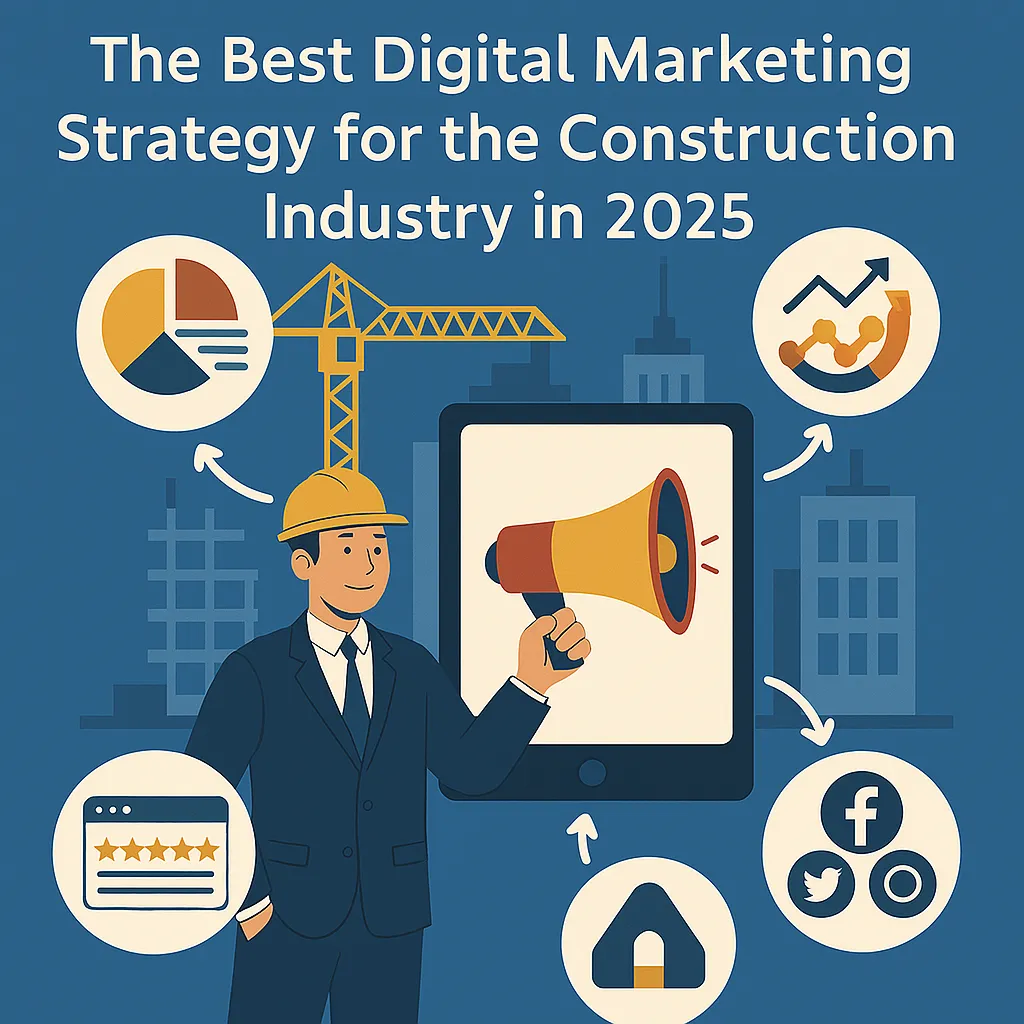
The construction industry, despite its traditional roots, is undergoing a digital transformation in 2025, making digital marketing a critical tool for competitiveness. With increasing competition and evolving customer behavior, construction companies must align their marketing strategies with the industry’s unique needs, such as long sales cycles and local focus. This article introduces the best specialized digital marketing strategy for the construction industry: a combination of video marketing and local SEO, supported by emerging trends like artificial intelligence, augmented reality (AR), and sustainability. These strategies are designed based on analysis of recent trends and successful case studies to help construction businesses attract customers, boost sales, and build a strong brand.
Marketing Challenges in the Construction Industry
The construction industry faces unique challenges that make digital marketing more complex:
Long Sales Cycles: Construction projects may take months or years, requiring consistent lead nurturing.
B2B Nature: Primary audiences include contractors, engineers, and real estate developers, necessitating specialized, professional content.
Trust and Credibility: Customers demand assurances of quality, timely delivery, and budget adherence, requiring showcases of successful projects and credible testimonials.
Local Focus: Many construction services are geographically specific, emphasizing the importance of local SEO and targeted advertising.
Project Complexity: According to the Revizto Report, 56% of industry professionals cite client changes and scope creep as key factors in costly revisions (Revizto Report).
These challenges demand targeted, specialized digital strategies to address the industry’s unique needs.
Insights and Key Tips for Success
The construction industry is a cornerstone of the economy, yet digital marketing in this sector differs significantly from other industries. As Reza Hojati, a digital marketing specialist with years of experience in various segments of the construction industry—from building materials and steel to interior design and elevators—I have gained valuable insights that I share in this article. These tips can help businesses in this industry enhance their digital marketing strategies and achieve better results.
1. Authentic, On-Site Images: The Key to Building Trust
One of the fundamental differences in digital marketing for the construction industry compared to other sectors is the presentation of product images. In many online sales domains, such as fashion or consumer electronics, high-quality images with professional lighting and multiple angles are standard to attract customers. These images are often heavily edited with polished backgrounds to make the product appear more appealing. However, in the construction industry, this approach may not only fail to deliver results but can sometimes backfire.
In this industry, audiences—particularly engineers and contractors—value images that are authentic and tangible. Photos taken in real construction environments, showcasing products in actual project settings, inspire greater trust. For instance, an image of a steel beam in a warehouse or on a construction site, with visible real-world details, is far more impactful than a studio-shot image with an artificial background. Such images convey that you are offering a practical, real-world product used in actual projects.
Practical Tips:
Avoid overly edited, studio-style images.
Capture photos in real project environments, warehouses, or construction sites.
Retain environmental details such as tools, other materials, or workers to convey authenticity.
2. Detailed Technical Specifications: A Sign of Professionalism
One of the most critical factors for success in online sales of construction products is providing precise and comprehensive technical specifications. Unlike many consumer goods that may sell based on general, appealing descriptions, construction industry customers demand detailed and specialized information. Including complete technical details—such as dimensions, material composition, production standards, strength ratings, and other specifications—not only demonstrates your expertise but also builds customer trust.
Unfortunately, many businesses in this sector settle for vague descriptions. For example, claiming a product is “high quality” without referencing relevant standards or specifications won’t convince an engineer or contractor. In contrast, providing precise details, such as ASTM standards for a type of steel or load-bearing specifications for a joist, can significantly influence a customer’s decision.
Practical Tips:
Dedicate a section to technical specifications for each product.
Provide detailed information, even if it seems obvious to you.
Reference credible industry standards (e.g., DIN, ASTM, or national standards) in your descriptions.
3. Presenting Information with Tables and Infographics
The primary audience in the construction industry—engineers, architects, and contractors—often have limited time to review information. They seek ways to quickly grasp the details they need. Therefore, presenting information through tables, charts, and infographics is highly effective. This approach not only delivers data concisely and clearly but also showcases your brand’s professionalism.
For example, if you’re selling ready-mix concrete, a table listing specifications like compressive strength, cement type, and mix ratios is far more effective than a lengthy paragraph. Infographics can also be used to compare products or illustrate production processes.
Practical Tips:
Use tables to display technical specifications clearly.
Design infographics to visually highlight key product features.
Organize information so audiences can access critical details in seconds.
4. Bridging the Gap Between Construction Engineers and Digital Marketing Experts
One of the main challenges in digital marketing for the construction industry is the linguistic and cultural divide between civil engineers and IT or digital marketing professionals. These groups often have different perspectives and priorities, which can lead to misunderstandings when addressing business needs. Construction engineers typically focus on the technical and practical aspects of products, while digital marketing experts may prioritize visual appeal and general marketing tactics.
This is where someone like me, Reza Hojjati, with combined expertise in civil engineering and digital marketing, becomes invaluable. I can act as a translator between these two groups, articulating the precise needs of construction businesses in a way that IT and digital marketing teams can understand. This enables the design of strategies that are both technically accurate and marketing-effective, ultimately driving successful sales.
Practical Tips:
Include team members with combined knowledge of civil engineering and digital marketing.
Hold regular meetings between technical and marketing teams to align needs and expectations.
Use project management tools to improve coordination between these groups.
The Best Strategy: Combining Video Marketing and Local SEO
Based on 2025 trends analysis, the most effective digital marketing strategy for the construction industry is a combination of video marketing and local SEO. This approach enables companies to:
Be easily found by local customers.
Build trust and differentiation through visual project showcases.
Nurture leads through complementary channels like email and social media.
1. Video Marketing
Videos are a powerful tool for the construction industry due to its visual nature. According to the Digital Marketing Institute, videos will account for over 82.5% of web traffic in 2025 (Digital Marketing Institute). Additionally, 93% of companies acquire new customers through branded videos (OpenAsset). In construction, videos can:
Visually and engagingly showcase completed projects.
Explain new construction technologies or material installation methods.
Build customer trust with video testimonials.
Practical Applications:
360-Degree Virtual Tours: Use virtual reality (VR) and augmented reality (AR) to showcase residential or commercial projects.
Educational Videos: Explain innovative construction technologies or material installation processes.
Short Reels and Videos: Publish 30- to 60-second videos on Instagram and TikTok for quick project showcases.
Video Testimonials: Feature satisfied customers discussing their collaboration experience.
Success Example:
McCarthy Building Companies increased organic traffic to sustainable project pages by 250% through project-focused videos (Oneupweb).
2. Local SEO
Given that 97% of potential customers search for construction services online, with 80% of these searches leading to conversions (OpenAsset), local SEO is critical for visibility in regional search results. This includes optimizing for local keywords, managing Google My Business profiles, and securing backlinks from reputable industry sites.
Practical Applications:
Optimize websites for phrases like “construction materials in Tehran” or “contractor in Shiraz.”
Update Google My Business profiles with high-quality images, contact information, and customer reviews.
Create blog content focused on local topics, such as “Tips for Choosing a Contractor in Isfahan.”
Collect positive reviews to enhance credibility in search results.
Success Example:
The Korte Company increased monthly website inquiries from 27 to 202 (a 650% growth) by optimizing for local searches and publishing downloadable content (Gorilla 76).
Complementary Strategies
To enhance this approach, the following strategies are recommended:
3. Content Marketing
High-quality content, such as blogs, case studies, and guides, builds customer trust and improves site rankings. Content marketing costs 62% less than traditional methods and generates three times more leads (OpenAsset).
Practical Applications:
Publish educational articles like “Guide to Choosing Precast Concrete.”
Create case studies of successful projects to showcase expertise.
Produce downloadable guides to capture leads, such as “How to Reduce Construction Costs.”
4. Social Media Marketing
Social media platforms like LinkedIn, Instagram, and Facebook are highly effective for engaging audiences and showcasing projects. LinkedIn is ideal for B2B marketing, while Instagram excels for visual content (Building Radar).
Practical Applications:
Share specialized articles and case studies on LinkedIn to attract contractors and engineers.
Use Instagram Stories and Reels to showcase visually appealing projects.
Run targeted social media ads to reach local customers.
5. Artificial Intelligence and Automation
Artificial intelligence (AI) and automation streamline repetitive tasks like email campaigns and social media posts. AI can also generate personalized content (Digital Marketing Institute).
Practical Applications:
Use tools like Building Radar to analyze customer behavior and market trends.
Automate email campaigns with platforms like ServiceTitan.
Produce AI-driven video content to reduce costs.
6. Sustainability and ESG
With growing environmental awareness, promoting green projects and environmental, social, and governance (ESG) factors can differentiate companies (Cemex Ventures).
Practical Applications:
Showcase sustainable projects, such as low-energy buildings.
Publish blog content about eco-friendly materials.
7. Virtual Reality and Augmented Reality (VR and AR)
VR and AR provide immersive experiences like virtual project tours, which are highly effective for engaging customers (Constructiv Digital).
Practical Applications:
Create 360-degree virtual tours of residential or commercial projects.
Use AR to showcase 3D models of proposed designs.
8. Voice Search Optimization
With the rise of voice assistants, optimizing for conversational queries like “best contractor near me” is essential (Smart Insights).
Practical Applications:
Optimize website content for conversational phrases.
Create FAQ sections to address voice search queries.
9. Employer Branding Marketing
With a shortage of skilled labor, digital marketing can attract and retain talent (Bofu).
Practical Applications:
Showcase company culture and employee benefits on social media.
Create dedicated career pages on the website.
Key Tools and Platforms
To implement these strategies, the following tools are recommended:
Tool | Application | Source |
|---|---|---|
Building Radar | Data analysis and market trend identification | Building Radar |
ServiceTitan | Email campaign and Google Ads management | ServiceTitan |
Google My Business | Enhancing local SEO and map visibility | OpenAsset |
Revizto | Collaboration in design and project efficiency showcases | Revizto Report |
HubSpot | Marketing automation and lead management | Digital Marketing Institute |
Successful Case Studies
The Korte Company
Strategy: Focused on local SEO and content marketing, creating downloadable content like “The Complete Guide to Warehouse Construction,” redesigning the website for better conversion paths, and conducting quarterly evaluations.
Results: Increased monthly website inquiries from 27 to 202 (650% growth) and secured an $8 million pre-construction contract for an aircraft hangar (Gorilla 76).
Key Takeaway: Combining targeted content and local SEO can generate high-quality leads.
McCarthy Building Companies
Strategy: Partnered with Oneupweb for SEO and video marketing, optimizing sustainable project pages and producing video content.
Results: Achieved 250% organic traffic growth, 771% increase in organic goal completions, and improved talent acquisition (Oneupweb).
Key Takeaway: Project-focused videos can create differentiation and trust.


